
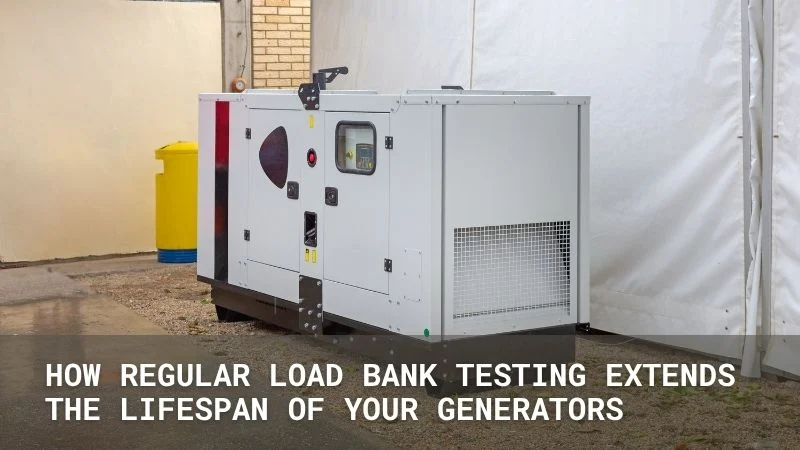
For any facility in Saudi Arabia that relies on backup or prime power generators, from data centers and hospitals to remote industrial sites, the expectation is simple. When the power goes out, the generator must start and perform flawlessly. However, a generator that sits idle or only runs on very light loads is at risk of a condition known as “wet-stacking,” which can severely degrade its performance and shorten its lifespan.
How do you ensure your high-value generator is ready to perform at 100% capacity when you need it most? The answer is regular load bank testing.
Why “Near Me” Matters in the Kingdom
As Saudi Arabia pushes toward Vision 2030, the demand for power reliability is surging. The Saudi data center market alone is projected to reach USD 7.7 billion by 2033. For these facilities, load bank testing isn’t just “maintenance”—it is a mandatory requirement for Tier III and Tier IV certifications.
Aramco Compliance: Pressure Systems Trading Company aligns with SATR-P-3824 standards for power system testing.
IKTVA Focus: Our localized service supports your In-Kingdom Total Value Add goals by providing on-site Saudi expertise.
Environmental Resilience: Our units are specifically tested at KSA’s high ambient temperatures to prevent thermal derating during testing.
Diesel generators are designed to operate at or near their rated power output. When a generator runs for extended periods on a light load (typically less than 30% of its capacity), the engine doesn’t reach its optimal operating temperature.
This leads to incomplete combustion of the diesel fuel. The unburned fuel and carbon soot can then enter the exhaust system, where they mix with moisture to form a thick, black, oily liquid—a condition known as wet-stacking.
The Dangers of Wet-Stacking:
Selecting the Right Test for Saudi Grids.
A standard resistive test isn’t enough for complex industrial grids. PSTC provides the full spectrum of testing:
Resistive Testing: Validates the fuel system and engine cooling capacity.
Reactive Testing: Essential for data centers to simulate a 0.8 power factor, testing the alternator and voltage regulators under inductive loads.
Medium Voltage (MV) Solutions: specialized units for 13.8kV and 33kV utility grids common in Saudi industrial cities (MODON).
A load bank is a device that simulates an electrical load, enabling you to run a generator at full capacity in a controlled, measurable way. By connecting a load bank, such as a high-quality unit from Avtron or Froment, you can simulate the demand of your entire facility without interrupting your actual operations.
How Load Bank Testing Helps:
Our load bank solutions cover:
Resistive & Reactive Testing
Low Voltage to High Voltage (LV/HV)
Portable units for remote sites
For critical backup generators, industry standards often recommend performing a load bank test annually. A typical test involves running the generator at its full rated load for a set period, usually several hours, while monitoring critical parameters like temperature, pressure, and frequency.
At Pressure Systems Trading Company, we offer state-of-the-art Avtron and Froment load banks for rental or for sale, providing you with the tools you need to implement a robust generator maintenance program. Our team can help you select the correct size and type of load bank for your specific generator set.
A generator failure during an outage costs more than a test. Schedule your load bank rental with PSTC today to certify your power readiness.
For mission-critical facilities like hospitals or data centers, standards often recommend monthly and annual testing. For general industrial standby generators, performing a full-load test annually is a widely accepted best practice to ensure reliability and prevent wet-stacking.
No, quite the opposite. When performed correctly by qualified technicians, a load bank test is a form of preventative maintenance. It safely “cleans out” engine deposits and helps identify potential weaknesses in a controlled environment before they can cause a failure during a real power outage.
The load bank’s kilowatt (kW) rating should match or exceed the generator’s prime power rating. This ensures you can test the generator at its full 100% capacity to verify its performance and effectively reverse the effects of light loading. PSTC can help you select the correct size Avtron or Froment unit for your specific needs.
To supply the right unit, we simply need the generator’s capacity (kW/kVA), the rated voltage (e.g., 400V, 480V, or 13.8kV), and the frequency (50Hz or 60Hz). Our engineering team at PSTC can help you determine the connection cable requirements and logistics for delivery to your site in Saudi Arabia.
PSTC combines international technical standards with deep local expertise. We don’t just provide the load bank hardware; we provide a comprehensive service compliant with Saudi Aramco and SEC requirements. Our localized presence ensures rapid deployment to remote oil fields, urban data centers, and Vision 2030 giga-projects.
Yes. Unlike basic resistive units, PSTC offers combined resistive/reactive load banks. These allow for the simulation of a 0.8 power factor, which is critical for testing the voltage regulation and alternator stability of generators serving high-density GPU clusters and AI data factories in Riyadh and NEOM.
By partnering with Pressure System Trading Company, you are working with a Saudi-based entity committed to the In-Kingdom Total Value Add (IKTVA) program. Our services utilize local technical talent and support the Kingdom’s industrial supply chain, helping our clients achieve higher localization scores in their own tenders.
Absolutely. Our fleet includes specialized units and transformers capable of testing from low voltage up to 13.8kV and 33kV utility grids. Whether it’s a standalone generator or a massive industrial power plant, PSTC has the specific load bank capacity to certify your system’s nameplate rating.
With strategic hubs across the Kingdom, PSTC offers industry-leading response times. We understand that in sectors like Oil & Gas or Healthcare, downtime is not an option. We provide 24/7 support to ensure your testing schedule is met without delaying your operations.
Operator response within 1 business day
This site is protected by reCAPTCHA, and the Google Privacy Policy and Terms of Service apply