
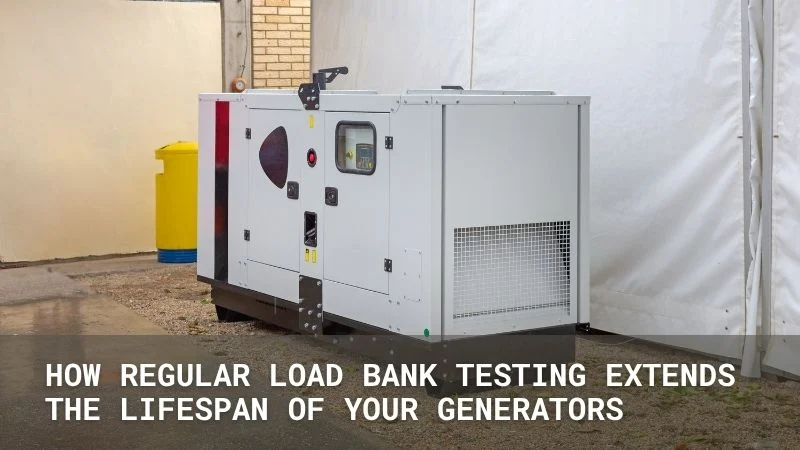
For any facility in Saudi Arabia that relies on backup or prime power generators, from data centers and hospitals to remote industrial sites, the expectation is simple. When the power goes out, the generator must start and perform flawlessly. However, a generator that sits idle or only runs on very light loads is at risk of a condition known as “wet-stacking,” which can severely degrade its performance and shorten its lifespan.
How do you ensure your high-value generator is ready to perform at 100% capacity when you need it most? The answer is regular load bank testing.
Diesel generators are designed to operate at or near their rated power output. When a generator runs for extended periods on a light load (typically less than 30% of its capacity), the engine doesn’t reach its optimal operating temperature.
This leads to incomplete combustion of the diesel fuel. The unburned fuel and carbon soot can then enter the exhaust system, where they mix with moisture to form a thick, black, oily liquid—a condition known as wet-stacking.
The Dangers of Wet-Stacking:
A load bank is essentially a device that creates an artificial electrical load, allowing you to run a generator at its full capacity in a controlled, measurable way. By connecting a load bank, such as a high-quality unit from Avtron or Froment, you can simulate the demand of your entire facility without interrupting your actual operations.
How Load Bank Testing Helps:
Our load bank solutions cover:
Resistive & Reactive Testing
Low Voltage to High Voltage (LV/HV)
Portable units for remote sites
For critical backup generators, industry standards often recommend performing a load bank test annually. A typical test involves running the generator at its full rated load for a set period, usually several hours, while monitoring critical parameters like temperature, pressure, and frequency.
At Pressure Systems KSA, we provide state-of-the-art Avtron and Froment load banks for sale or rental, giving you the tools you need to implement a robust generator maintenance program. Our team can help you select the correct size and type of load bank for your specific generator set.
A generator failure during an outage costs more than a test. Schedule your load bank rental with PSTC today to certify your power readiness.
For mission-critical facilities like hospitals or data centers, standards often recommend monthly and annual testing. For general industrial standby generators, performing a full-load test annually is a widely accepted best practice to ensure reliability and prevent wet-stacking.
No, quite the opposite. When performed correctly by qualified technicians, a load bank test is a form of preventative maintenance. It safely “cleans out” engine deposits and helps identify potential weaknesses in a controlled environment before they can cause a failure during a real power outage.
The load bank’s kilowatt (kW) rating should match or exceed the generator’s prime power rating. This ensures you can test the generator at its full 100% capacity to verify its performance and effectively reverse the effects of light loading. PSTC can help you select the correct size Avtron or Froment unit for your specific needs.
To supply the right unit, we simply need the generator’s capacity (kW/kVA), the rated voltage (e.g., 400V, 480V, or 13.8kV), and the frequency (50Hz or 60Hz). Our engineering team at PSTC can help you determine the connection cable requirements and logistics for delivery to your site in Saudi Arabia.